What the Body Knows: Five Gestures That Cannot Cross a Border
The travel writing world has spent the better part of a decade celebrating untranslatable words. Saudade, hygge, mono no aware—these linguistic rarities have become cultural shorthand for the idea that other peoples experience the world differently than we do. Yet linguists and anthropologists have long argued that the more revealing frontier lies not in dictionaries but in the body itself. The hand that rises mid-sentence. The gaze that drops at precisely the right moment. The almost imperceptible nod that carries the weight of a paragraph.
These are gestures that resist translation not because we lack the vocabulary, but because the concepts beneath them do not exist in every culture's emotional or social architecture. For American travelers accustomed to an expressive, forward-facing body language tradition—one that prizes the firm handshake, the direct gaze, and the open-armed welcome—encounters with these embodied codes can be disorienting, even humbling. They are invitations to reconsider what we assume to be universally human.
The Turkish Chin Lift: Negation Without Words
Visitors to Turkey frequently report a peculiar moment of confusion during their first days in Istanbul or Ankara. They ask a shopkeeper a simple yes-or-no question. The shopkeeper tilts their chin upward—a swift, almost imperceptible movement—and says nothing, or perhaps makes a soft clicking sound with the tongue. The visitor, interpreting the gesture as a kind of thoughtful pause, asks again. The shopkeeper repeats the motion. What has been communicated, clearly and completely, is no.
Dr. Asli Özyürek, a cognitive scientist at the Max Planck Institute for Psycholinguistics who has studied Turkish gesture extensively, describes this chin lift as a deeply embedded negation that predates modern Turkish by centuries, with roots across the broader Mediterranean and Middle Eastern world. "It is not merely a substitute for the word," she has noted in published research. "It is a different cognitive pathway to the same destination." For American travelers, who associate upward head movements with affirmation or enthusiasm, the inversion is not just confusing—it briefly restructures the logic of the interaction entirely.
The Japanese Aizuchi: Listening as Participation
In American conversational culture, silence from a listener is often read as disengagement or disagreement. We are trained, almost from childhood, to signal our attention through facial animation, murmured affirmations, and the occasional interjection. Japanese conversational practice operates on a fundamentally different premise.
Aizuchi refers to the continuous, rhythmic back-channel responses a Japanese listener offers while another person speaks—small sounds, nods, and brief verbal cues that signal not agreement with content, but active presence in the exchange. What makes aizuchi genuinely untranslatable as a gesture is its density and precision. The specific timing, frequency, and physical form of these responses communicate degrees of understanding, emotional attunement, and social respect that a Western observer may entirely miss or misread as interruption.
Cross-cultural communication researcher Harumi Befu, whose work on Japanese social interaction remains foundational in the field, described aizuchi as "the sound of the relationship being maintained in real time." American travelers who learn to recognize it—and resist the urge to fill what they perceive as silence—frequently describe the experience of a Japanese conversation shifting from opaque to profoundly intimate.
The West African Dap: A Handshake That Tells Your History
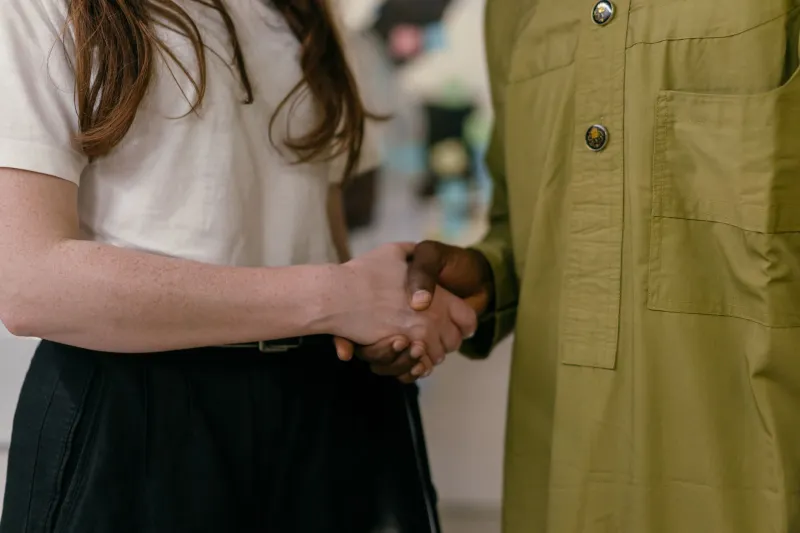
The handshake, in its American form, is a compressed ritual: firm, brief, and largely informational. In many West African cultural traditions, the greeting gesture between men—often called a dap in its diaspora form, though it takes dozens of regional variations across Ghana, Senegal, Nigeria, and beyond—is something categorically different. It is a negotiated, semi-improvised sequence of clasps, snaps, pulls, and holds that can last thirty seconds or more and communicates social standing, shared history, regional origin, and the precise nature of the relationship between two people.
Anthropologist Elaine Salo, who has written on embodied identity in sub-Saharan Africa, argues that these greeting sequences function as a kind of kinetic biography. "Two men who have never met can locate each other socially through the gesture itself," she has observed. For the uninitiated outsider, the dap is not merely a greeting to be imitated—it is a text written in a script one has not yet learned to read. Attempting it without understanding its grammar risks communicating precisely the wrong thing.
The Neapolitan Mano a Borsa: When the Hand Becomes a Question
Southern Italian gesture culture is among the most extensively documented non-verbal communication systems in the Western world, yet it remains startlingly misunderstood by outsiders. The mano a borsa—literally "purse hand," formed by pressing all five fingertips together and pointing them upward while moving the hand in a short up-and-down motion—is perhaps its most iconic example.
American visitors to Naples or Palermo often encounter this gesture and assume, based on its resemblance to a vague pointing motion, that it signals direction or emphasis. In practice, it is a fully formed interrogative: What do you want? What are you doing? What does this mean? It carries, depending on context and the relationship between speakers, tones ranging from genuine curiosity to exasperated incredulity. Linguist Adam Kendon, whose decades of fieldwork on Italian gesture produced the landmark study Gesture: Visible Action as Utterance, argued that the mano a borsa represents a case where gesture has achieved the semantic autonomy of a word—it can stand entirely alone, without speech, and complete a communicative act. That autonomy, and the cultural specificity of its meaning, makes it effectively untranslatable.
The Māori Hongi: Breath as Covenant
The hongi, the traditional Māori greeting in which two people press foreheads and noses together and share breath, is perhaps the most philosophically distinct gesture on this list. It is not a stylized performance of affection, nor a formal display of respect in the way a bow might be. Within its proper cultural context, the hongi is understood as the exchange of hau—a concept that encompasses breath, life force, and the animating spirit of a person.
For Māori communities in Aotearoa New Zealand, the hongi is a threshold act: the moment when a visitor ceases to be a stranger and becomes, at least temporarily, a part of the community. Māori cultural educator Rangi Mātāmua has described it as "the moment the boundary between self and other becomes permeable." American travelers who receive a hongi in a formal or ceremonial context sometimes describe the experience as unexpectedly moving—not because the gesture resembles anything in their own cultural repertoire, but precisely because it does not. It asks the body to understand something the mind has no existing framework for.
Reading the World Without Words
What these five gestures share is not simply their resistance to direct translation. Each one reveals something about the society that produced it: the Turkish chin lift reflects a Mediterranean comfort with economy of expression; aizuchi embodies a Japanese ethic of relational presence; the West African dap encodes community memory in the body; the mano a borsa demonstrates how a gesture can achieve the full independence of language; and the hongi makes visible a cosmology in which the boundary between persons is not fixed.
For American travelers, who often arrive in foreign countries armed with phrase books and translation apps, these gestures offer a different kind of preparation. They suggest that the most important things a culture communicates may never appear in any dictionary—and that genuine cross-cultural understanding begins not with the tongue, but with the willingness to let the body become a student.