Stone, Clay, and Meaning: What Five Ancient Structures Tell Us About the Civilizations That Built Them
When an American tourist photographs the Colosseum or posts a selfie in front of Machu Picchu, the instinct is understandable: these places are visually extraordinary. But the more consequential question — the one that separates a traveler from a witness — is not what these buildings look like. It is why they were built the way they were. Architecture is, at its core, a society's most durable argument about what matters. Stone outlasts language. Clay walls survive dynasties. And the choices a civilization makes when it decides to build something permanent — what materials to use, what orientation to adopt, who is permitted inside — constitute a kind of cultural autobiography.
Across five continents, five structures offer that autobiography in vivid detail.
Japan: The Impermanence Built Into Ise Jingū
The Grand Shrine of Ise, located in Mie Prefecture, is arguably the most sacred site in Shinto tradition. What makes it architecturally remarkable — and philosophically disorienting to many Western visitors — is that it is ritually demolished and rebuilt every twenty years. The current structure is, depending on when you visit, somewhere between one and twenty years old. The idea of the shrine, however, is over a millennium ancient.
This practice, known as Shikinen Sengū, encodes a distinctly Japanese relationship with permanence and renewal. Rather than treating decay as failure, Ise Jingū treats it as inevitability — and responds with intentional, ceremonial regeneration. The building materials, harvested from a sacred forest maintained specifically for this purpose, are reused in smaller shrines across Japan after demolition. Nothing is wasted. Everything cycles.
For a culture that has long balanced aesthetic appreciation of impermanence (mono no aware) with rigorous craft tradition, Ise Jingū is not a contradiction. It is a thesis statement.
Mali: The Great Mosque of Djenné and the Architecture of Community
The Great Mosque of Djenné, constructed of sun-dried mud brick and standing on the floodplain of the Niger River, is the largest mud-brick structure on Earth. It is also, uniquely, a building that the entire community is expected to maintain. Each year, after the rainy season softens and erodes its exterior, residents of Djenné gather for a collective replastering festival — a social event as much as a civic one.
This is not a detail. It is the point.
In Sahelian West African building traditions, the mosque was never intended to be a monument maintained by specialists or state institutions. Its very material — mud, locally sourced and structurally vulnerable — demands ongoing human attention. The architecture requires community participation to survive. In this sense, the Great Mosque of Djenné is a built argument that spiritual life and communal responsibility are inseparable. A congregation that stops gathering to repair its mosque loses the mosque. The theology is embedded in the masonry.
Peru: Sacsayhuamán and the Logic of Collective Survival
Perched above the city of Cusco at an elevation exceeding 12,000 feet, the Inca fortress complex of Sacsayhuamán presents modern engineers with a puzzle that remains only partially solved. Its massive limestone blocks — some weighing over 100 tons — were transported from quarries miles away and fitted together without mortar with a precision that leaves no room for a sheet of paper between stones.
The Inca Empire operated on a labor-tax system called mit'a, in which citizens contributed time and labor to the state in lieu of monetary payment. Sacsayhuamán was built through this system — a collective undertaking of staggering scale. What it reveals about Andean civilization is not just technical ingenuity, but a social architecture that matched its physical one: a society in which individual effort was understood as inseparable from collective survival at altitude, in seismic territory, against the demands of an unforgiving landscape.
The stones, famously, were also cut to interlock in ways that absorb earthquake energy. The builders of Sacsayhuamán were not defying their environment. They were negotiating with it.
Cambodia: Angkor Wat and the Cosmology Made Concrete
Angkor Wat was constructed in the twelfth century as a Hindu temple — and later converted to Buddhist use — representing the cosmic mountain of Mount Meru, the axis of the universe in both traditions. Its moat symbolizes the oceans. Its towers represent the mountain's peaks. Its galleries are arranged so that the rising sun aligns with the central spire on the spring equinox.
Every measurement, every orientation, every decorative panel was chosen to replicate a divine order that the Khmer king was understood to inhabit and protect. To walk through Angkor Wat was not to enter a building in any ordinary sense. It was to enter the universe as the Khmer understood it — layered, hierarchical, and suffused with divine presence.
For American visitors accustomed to a separation between civic and religious architecture, Angkor Wat can be disorienting. Here, there was no separation. The state was the cosmos. The king was the divine axis. And the building made that claim in sandstone, at a scale that still overwhelms the senses nine centuries later.
Greece: The Parthenon and the Politics of Beauty
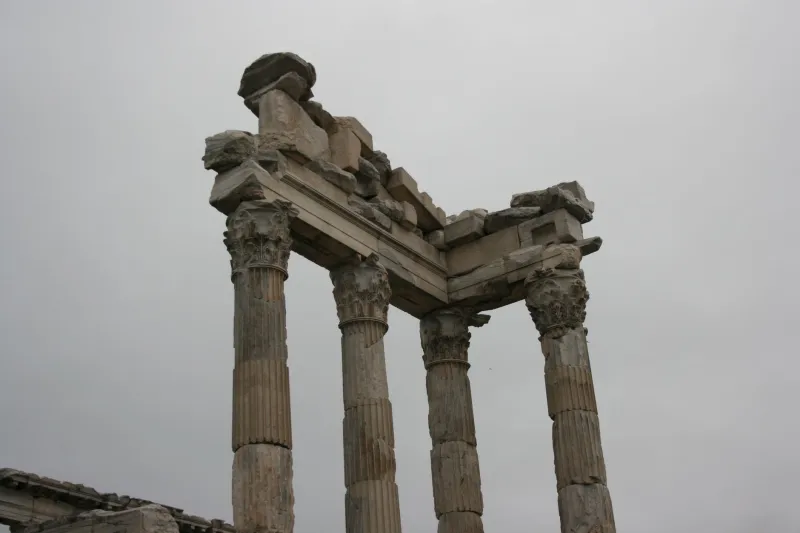
The Parthenon is so familiar to Western eyes that it risks becoming invisible. But its design choices were radical for their time and deliberate in ways that still reward examination. Its columns lean slightly inward. Its floor curves subtly upward at the center. These refinements — collectively called entasis — were introduced to correct for optical illusions that would otherwise make the building appear to sag or warp.
The Athenians who commissioned the Parthenon in the fifth century BCE were not simply building a temple to Athena. They were constructing an argument about the relationship between reason, beauty, and civic virtue. The building's mathematical precision was a declaration that the polis — the democratic city-state — was capable of perfection. Its hilltop placement was a statement of civic pride visible from the sea.
That this building also housed the treasury of the Delian League, essentially the Athenian imperial fund, is a reminder that architecture can simultaneously encode idealism and power. The Parthenon is honest about both.
Buildings as Texts
What these five structures share is not aesthetic style, not geographic proximity, and not religious tradition. What they share is the quality of argument. Each one makes a claim about the world — about what is sacred, who belongs, how power is organized, and what a society owes to the generations that will follow.
For travelers willing to read buildings the way they read books, the world becomes significantly more legible. The next time you stand before a structure that has outlasted the civilization that built it, the most important question is not how old it is. It is what it was trying to say — and whether, centuries later, we are still listening.